Feature Overview
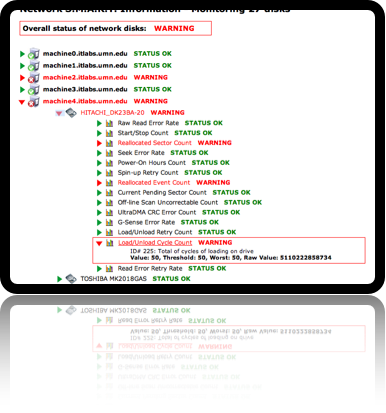
The smartNET Network Disk Sentinel is almost entirely scripted in Python. As such, it is compatible with Windows, Linux, and Mac OS X in both the server and client. The client is a daemon type program, which periodically queries disks in the system by invoking smartmontools and sends this information to the server. The server requests S.M.A.R.T. information from each client, and displays said data for all systems via the web interface.
On the client, the python script can either be run from the command interface, or installed to run in a service-like fashion on each system startup. The server and GUI reside on a single machine, and can likewise be invoked via a command line or run as a startup service. Both client and server feature a minimal amount of processing, ensuring the solution is both low-overhead and highly scalable.


Client OS: Windows Vista/XP/2000, Linux, Mac OS X
Server OS: Windows Vista/XP/2000, Linux, Mac OS X
Currently Tested: Windows XP SP2, openSUSE 10.0, Slackware 10.2, Mac OS 10.4
License: BSD
Server Tech: Python Daemon
GUI Tech: Python, CSS/Javascript
Unreleased Features
Plans for future released of smartNET include a much more configurable and powerful GUI. The user will be able to configure e-mail alerts alerting the administrator of possible unhealthy or failed disks, as well as systems which are no longer responding to requests for data. It will also allow the user to view the S.M.A.R.T. data in other useful ways. The user will be able to view graphs displaying how disk health characteristics have changed over time. There are also plans to implement a “view by attribute” screen where, for example, the user can have a sorted view of the temperature or power-on hours of every disk on the system.
More work will also be done in packaging the client and server software into easily installable packages which reduce the dependency on a previous installation of python and smartmontools on the system.
